Pork belly on the same counter varies in thickness, in the proportion of fat and in weight. If it is for grilling, look at the thickness first, check the country of origin, the use-by date and the weight on the packaging, and then compare the state of the meat.
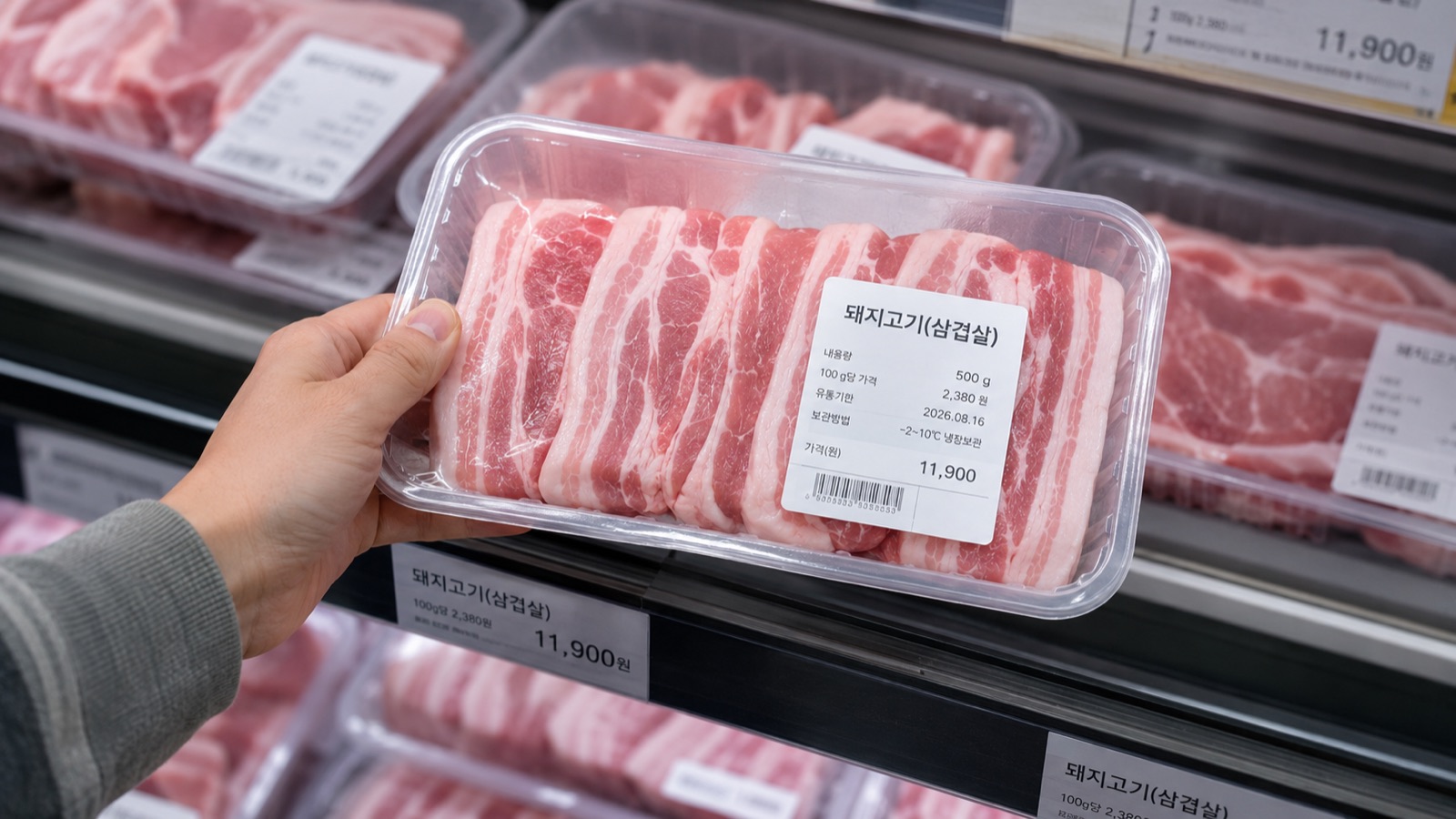
- For grilling, start with thickness
- Thin pork belly and thick pork belly are grilled differently. If the thickness is stated, check the mm or cm; if it is not stated, look at the cut face on the side of the pack.
- Labeling
- Check the cut name, country of origin, use-by date, storage method, weight and traceability number.
- The meat itself
- Look at whether too much juice has collected at the bottom of the pack, and whether the fat is gathered on one side. The color can change with the packaging method and the lighting.
- Comparing prices
- Looking at the price per 100g rather than the total lets you compare products of different weights straight away.
For grilling, start with the thickness
Even with the same pork belly, a thinly sliced product and one cut thick at around 2cm are grilled differently.
Decide first whether you will cook it quickly in a frying pan at home or grill it thick over charcoal or on a grill.
Some products state the thickness on the packaging or in the product name, such as 10mm, 15mm or 20mm. If there is no number, check the cut face of one slice on the side of the pack.
Seen from above, the slices are stacked and the thickness is hard to judge. Frozen products are also hard to check when there is frost or the slices are stuck together, so if thickness matters a product with the specification stated is easier.
At the butcher counter you can also ask for the thickness you want.
On the packaging, this is all you need to check
Pork belly packaging carries the information you need for comparing products as well as the price.
| Labeling | What to check |
|---|---|
| Cut name | The cut as written on the packaging: pork belly, 오겹살 and so on |
| Country of origin | Whether it is domestic or imported |
| Use-by date | The use-by date when the stated storage method has been followed |
| Storage method | Whether it is chilled or frozen, and the storage conditions |
| Weight | The actual amount of meat packed |
| Traceability number | The number used to look up the record at 축산물이력제 |
Phrases such as "for grilling" or "for boiling" indicate the cooking use. It is more accurate to check the cut name separately for the actual cut.
Products with different packing dates and use-by dates can be mixed on the same counter, so look at the dates as well.
Look at the juice and the distribution of fat
While it is still packaged, the easiest things to look at are the bottom of the pack and the cut face of the meat.
Start with the juice collected at the bottom of the pack. If one pack among similar products has noticeably more juice collected, it is worth comparing it with the others.
It is hard to judge freshness from color alone. Vacuum-packed meat does not meet oxygen so it can look darker than meat in ordinary packaging, and the color also changes with the store lighting.
With pork belly you can also see the distribution of fat by eye.
Whether you want fat and lean mixed in balance, or want pork belly with plenty of fat, is a matter of taste. But in a pack where the fat layer is heavily gathered on one side, the amount of lean you can actually eat once it is grilled may be less than you expect.
The proportion of fat differs even within one pack
Pork belly comes from the belly of the pig, so the proportion of fat layer to lean differs by position.
That is why, even within one pack, some slices can have more fat and others more lean. This is not necessarily a quality problem.
That said, with packaged meat only the top is usually clearly visible. If the proportion of fat matters to you, choose a product where the whole pack is relatively visible, or look at the meat yourself and order at the butcher counter.
When the weights differ, look at the price per 100g
Even if two packs of pork belly are priced at 13,000 won and 16,000 won, the total alone does not tell you which is cheaper.
For example, 500g at 13,000 won is 2,600 won per 100g, and 600g at 16,000 won is about 2,667 won.
When comparing products of different weights, check the price per 100g marked on the packaging. If it is not marked, you can calculate it like this.
Total price ÷ weight in grams × 100 = price per 100g
It is useful when comparing prices between products that are similar in brand, country of origin and certification.
At the butcher counter, state the thickness and the weight
If you cannot find the specification you want among the packaged products, you can ask for it directly at the butcher counter.
Saying the use, the thickness and the weight, as in "pork belly for grilling, about 2cm, 800g please", is the most precise.
Ordering by a set weight is better than stating only the number of people. How much people eat differs a great deal from person to person.
For an ordinary grilling occasion you can start at around 150 to 200g per person and adjust for the amount of rice and side dishes and whether there is other meat as well.
What grade 1+ means
Some pork products carry a mark such as grade 1+, 1 or 2.
Pork grades are not assigned by looking at one pack of pork belly; they are assigned on the carcass after slaughter. Specification items such as carcass weight and backfat thickness are assessed against the standards together with meat quality items.
So even for pork of the same grade, the distribution of fat, the thickness and the trimming of the pork belly you see in the store can differ.
The grade is information you can refer to when choosing meat, but it is not a mark that shows the state of the pork belly inside the pack for you.
The order to check in at the store
At the pork belly counter, this much is enough.
- Decide how you will grill it
- Check the thickness
- Check the country of origin and the use-by date
- Check the juice and the distribution of fat
- Compare the price per 100g
If you are torn between two packs with similar conditions, comparing the use-by date and the price per 100g at the end makes it easy to choose.
Frequently asked questions
There is no one set thickness. Thin meat cooks quickly, and thick meat needs more grilling time. Choose according to whether it is a frying pan or charcoal or a grill.
First look for an mm or cm marking in the product name or on the label. If there is none, you can check the cut face of one slice on the side of the pack.
The presence of juice alone is not enough to conclude that the meat is old. But if one product among those in similar condition has noticeably more liquid collected, it is worth comparing it with the other packs.
It is hard to judge by color alone. Vacuum-packed meat in particular does not meet oxygen, so the color can look darker.
Grade 1+ is a grade for the pig carcass. It is not a grade that assesses the thickness, the distribution of fat or the trimming of one pack of pork belly sold in a store.
Among the pork sold in stores, 오겹살 is generally used to refer to pork belly with the skin left on. When buying, check the cut name and the product information stated on the packaging.