You have probably experienced this: the outside of the pork belly is already charred while the inside is still undercooked. Or the opposite — you looked away for just a moment and thin slices dried out completely. Heat level plays a role, but the first thing to look at is the thickness of the meat.
Pork belly sliced to about 1cm and pork belly cut to 2cm will turn out differently if you grill them the same way. The thicker the cut, the longer it takes for heat to reach the center.
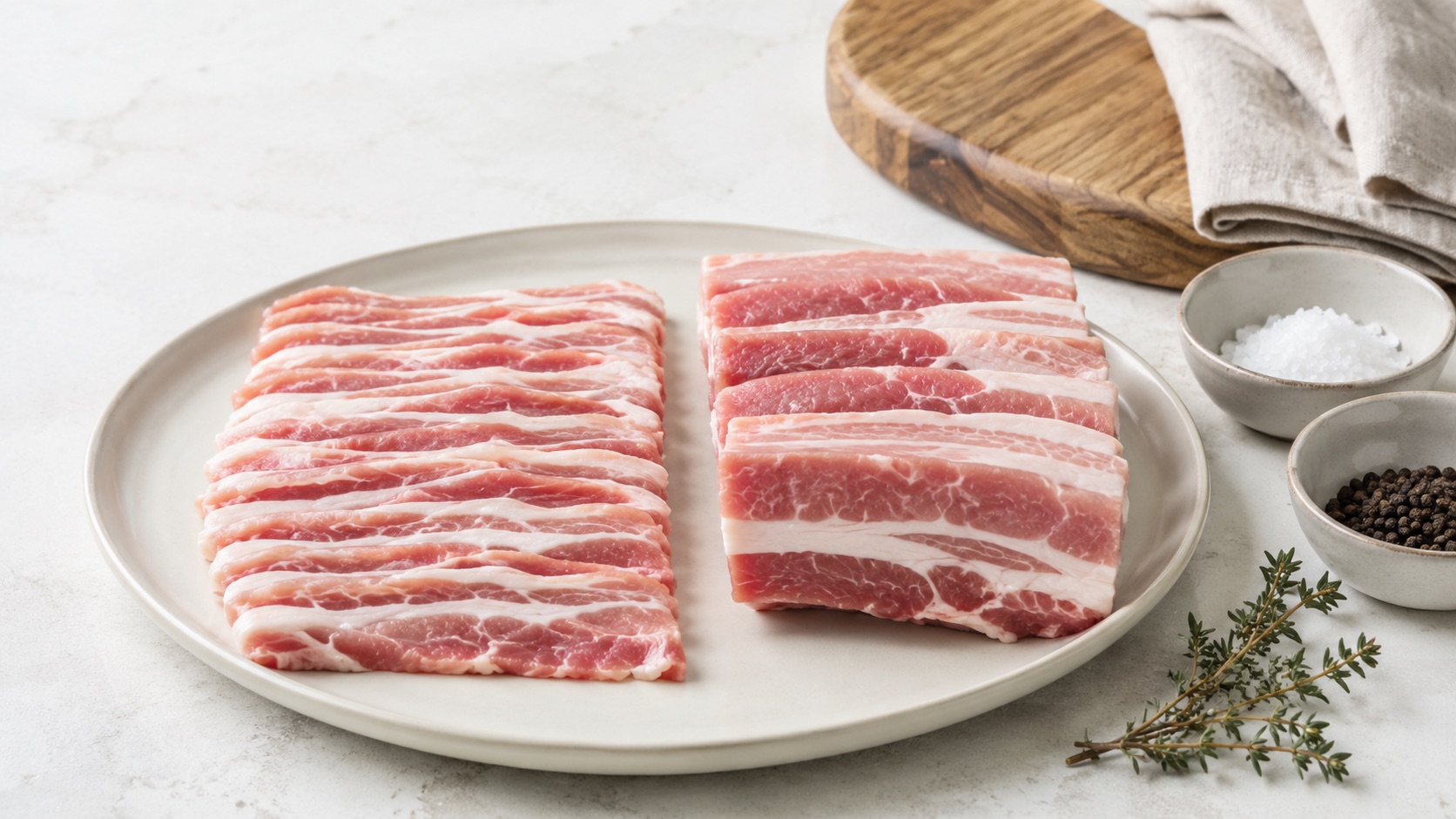
- Around 1cm
- Heat the pan thoroughly, then grill over medium-high heat. When the cooked color reaches the edges, flip and cook the other side a bit shorter. Cut into bite-sized pieces after grilling, not before.
- Around 2cm
- Sear both sides over high heat first. Stand the meat on its fat-heavy edge and cook that too, then lower the heat to cook the interior through. Finally, cut into pieces and briefly sear the cross-sections.
- Doneness
- The standard for pork is an internal temperature of 75°C for at least 1 minute. A cooking thermometer at the thickest point is the most reliable check.
- Before buying
- Check the product detail page for the thickness in cm. Some products offer thickness options, and at a butcher counter you can simply ask for the thickness you want.
Why grilling changes with thickness
When meat hits a hot surface, the outside starts cooking first. Heat from the surface gradually moves inward, and the thicker the meat, the longer it takes for heat to reach the center.
With thin pork belly, by the time the surface turns golden brown, the inside is already mostly cooked. There is no reason to leave it on longer. In fact, even a brief delay can cause moisture to escape and the meat to stiffen.
At around 2cm, the situation changes. The surface may be nicely browned while the center is still cooking. It is better to separate the time spent browning the outside from the time spent cooking the inside through.
Sear the front, back, and sides over high heat first, then lower the heat to cook the interior. Over charcoal, this means moving the meat to a cooler spot. At the end, you can cut it open to check and sear the cross-sections briefly.
Safe doneness for pork cannot be judged by surface color alone. Korea's Ministry of Food and Drug Safety recommends heating meat to an internal temperature of 75°C for at least 1 minute. Especially with thick cuts, a cooking thermometer at the thickest part is the most reliable method.
Before placing meat on heat
Freshly unwrapped meat often has moisture on the surface. If you place it on a hot pan in this state, the surface moisture evaporates first instead of browning right away.
Lightly press both sides with a paper towel to remove surface moisture. No need to press hard or wipe for a long time.
Preheat the pan thoroughly as well. Placing meat on a cold pan and heating both together causes fat and moisture to seep out first — the meat ends up more like it is boiling in liquid than being grilled.
Avoid overcrowding the pan. Even on a large pan, filling every gap with pork belly will drop the pan temperature all at once from the cold meat. Leave enough space so that some of the cooking surface shows between the pieces.
Thick meat straight from the refrigerator in particular will cause a larger temperature drop. For 2cm or thicker cuts, give each piece room rather than loading several at once — this makes it easier to develop color on the surface.
Thin-sliced, around 1cm
This is the thickness you commonly see in standard grilling cuts at the supermarket. Heat reaches the center quickly, so the meat cooks fast — but it is not the kind of meat you leave on for several minutes.
Place the meat only after the pan is hot so that the contact side starts cooking immediately. If the pan is not hot enough, liquid and fat from the meat pool on the surface, and it takes longer to develop a golden color.
As one side cooks, the color along the edges gradually changes. When the bottom side has developed color and the cooked tone reaches the edges, it is time to flip. After flipping, cook the other side a bit shorter than the first — heat from below has already started working toward the center.
You do not need to limit yourself to flipping only once. If the heat is strong or the thickness is uneven, flip once or twice more as needed. What matters is not the count, but not leaving one side unattended for too long.
Pork belly around 1cm does not need to be cut into small pieces from the start. Grill it in large pieces first. Cut it when it is nearly done.
Once cut, there is no need to grill the pieces for long. Thin meat loses moisture quickly once it has been divided into small pieces.
Thick-cut, around 2cm
This is the thickness you often find in pork sold for camping or barbecue. It is too thick to finish with the same approach as standard grilling cuts — cooking one side for a while, flipping, and calling it done.
From this thickness onward, it helps to think of browning the surface and cooking the interior as two separate phases.
Place the meat on a thoroughly heated cooking surface and grill the two wide faces first. Rather than starting on low heat for a long time, focus on developing a golden-brown color on the surface. Once both sides show browning, move to the next step. The inside does not need to be fully cooked at this point.
Thick pork belly has a wide band of fat visible from the side. If you only sear the front and back, this section may not cook through. Use tongs to hold the meat so the fatty edge contacts the cooking surface directly. Cook until the fat turns translucent and the surface begins to take on some color.
Once the front, back, and sides are well browned, there is no need to keep it on high heat. Turn down the gas, or move the meat to a cooler spot over charcoal. The outside is already well grilled — now you are giving the center time for heat to reach it.
Cutting into bite-sized pieces and briefly searing the cross-sections makes thick pork belly much easier to cook through. This technique is especially useful over charcoal, where heat control is difficult. The freshly cut surfaces are in direct contact with the heat and cook quickly. There is no need for a long finish — just a short sear as needed.
When thickness doubles, the distance from surface to center also doubles. That said, cooking time does not scale exactly by the same factor. Pan temperature, the starting temperature of the meat, fat content, and the type of cooking surface all play a role.
For 2cm and above, rather than memorizing a set number of minutes, it is more useful to remember the sequence: sear the surface, lower the heat, then check the center.
The same applies at camp. Over charcoal, you cannot lower the heat instantly like on a gas stove, but with thick cuts you can sear the surface over the hot zone, then move the meat to a cooler spot or cut it and finish the cross-sections.
What changes by thickness
| Thickness | Heat level | When to flip | When to cut | Watch out for |
|---|---|---|---|---|
| Around 1cmStandard grilling | Medium-high | When cooked color reaches the edges | After nearly fully cooked | Dries out easily if overcooked |
| Around 2cmCamping / BBQ | High at first, then reduced | When both sides are well browned | After searing surfaces; finish the cross-sections | Outside done but center may still be raw |
| 3cm or moreWhole slab | Low temperature, cook thoroughly | Hard to judge by surface color alone | After the center is cooked through | Check with internal temperature |
Even with the same 2cm pork belly, the time it takes on a frying pan and over charcoal will differ. Whether it came straight from the fridge, how many pieces are on the surface at once — these factors also matter. Rather than setting a fixed time like "3 minutes per side, 2 on the other," watch the surface color and the state of the meat, and check the internal temperature when possible.
What changes by cooking surface
Even at the same thickness, the grilling feel changes noticeably depending on the cooking surface.
A cast-iron pan or a thick stone plate takes time to preheat. Once thoroughly heated, however, it holds its temperature relatively well even when cold meat is placed on it. This makes it convenient for developing the initial sear on thick cuts around 2cm.
A thin stainless-steel pan reacts quickly. It heats up fast, and when you lower the flame, the temperature drops relatively quickly too. Conversely, loading several cold pieces at once can cause a rapid temperature drop.
A wire grill grate is a bit different. Fat dripping from the pork belly falls through, so oil does not pool on the surface. However, when dripping fat catches fire on the coals below, a flare-up can shoot up.
If flames touch the meat directly, it can quickly char black — move the meat aside when this happens. Setting up a hot zone and a cool zone over charcoal makes it much easier to grill thick cuts.
If a flat grill plate has a lot of pooled pork belly fat, wipe or drain some of it off mid-cook. Too much fat can leave the meat simmering in grease, producing a different texture than what you want.
How shoulder butt and front leg differ
You cannot directly apply the thickness guidelines from pork belly to other cuts.
Shoulder butt (목살) does not have long continuous fat layers like pork belly — instead, fat is marbled throughout the lean meat. Even thick slices grill up relatively moist, which is why thick-cut shoulder butt around 2cm is commonly available.
The grilling method is not much different from thick pork belly. Sear both sides over high heat first, then lower the heat to cook the interior. With shoulder butt as well, check the internal temperature as it gets thicker.
Front leg (앞다리살) serves a somewhat different purpose. It has relatively less fat, so grilling thick pieces over high heat for a long time can make them tough and dry quickly.
Thinly sliced front leg for grilling should be cooked briefly. Large, thick pieces of front leg are better suited to wet-heat methods like boiled pork, stew, or braising.
Rather than declaring one thickness best for all pork, consider the cut and the cooking method together.
Why resting after grilling helps
For thick cuts of 2cm or more, there is a case for letting the meat sit briefly after removing it from heat rather than cutting into it immediately.
Even after the meat leaves the heat source, residual heat remains inside. During a short rest, the internal temperature evens out to some degree. It is the same principle behind resting a thick steak after cooking.
That said, pork belly is high in fat, and the fat solidifies quickly once it cools. Resting too long makes the flavor drop. Rather than timing it by minutes, simply moving it to a cooler spot on the grill plate while you cook the next batch is usually enough.
Thin pork belly around 1cm does not need resting. It is thin enough to cool down quickly, so eat it right after grilling.
At a campsite where the outside temperature is lower, this is even more true. Instead of pulling the meat onto a plate entirely, use the residual heat at the edge of the grill to keep it from cooling too fast.
How to check thickness before buying
When you go to buy pork, weight and price are displayed prominently, but thickness is often hard to find.
Many products are labeled something like "pork belly for grilling, 500g" with only the purpose shown, without specifying the actual mm or cm. When thickness matters — for camping or barbecue, for example — do not stop at the product name; check the detailed product information.
The first thing to look for is whether the thickness is stated as a number. If it says 10mm, 15mm, or 20mm, comparison is easy.
The second thing is options. Some products let you choose between thin, standard, and thick, or between "for grilling" and "for boiling" — different cutting methods for the same pork belly.
If you buy at a supermarket or butcher counter, it is even simpler. Just state the thickness you want and ask them to slice it. For home grilling, request your usual preference; for camping, you might ask for around 2cm.
For pre-packaged meat, looking at the side of the pack is more informative than looking from above. When multiple slices are stacked, you cannot tell the thickness of a single slice from the top, but the cross-section is visible from the side.
With frozen products, photos alone may not convey thickness accurately. If you want to buy a specific thickness for camping, choosing a product that lists actual dimensions on the detail page is the surest approach.
Frequently asked questions
You do not need to set a fixed number. For thin pork belly around 1cm, waiting until one side has developed good color, then flipping and briefly cooking the other side, is often enough. For thicker cuts, you need to cook the front, back, and sides evenly, so flipping multiple times while watching the state of the meat is fine.
Yes. However, if you cut thin pork belly into small pieces from the start, it dries out quickly, so grill it in large pieces first. For thick cuts of 2cm or more, sear both sides first, then cut and finish cooking the cross-sections — this also makes it easy to check doneness.
Korea's Ministry of Food and Drug Safety recommends heating meat to an internal temperature of 75°C for at least 1 minute. With thick pork, it is difficult to judge internal doneness by surface color alone, so using a cooking thermometer to check the thickest part is the most reliable method.
The basic sequence is similar, but the way you control heat differs. With a frying pan, you can adjust the gas or induction level instantly, but charcoal does not work that way. Over charcoal, it helps to set up a hot zone and a cool zone from the start and move the meat between them.
It is difficult to determine exact thickness from the label "for grilling" alone. Cutting specifications can vary by retailer and product. When thickness matters, check the product detail page for mm or cm markings, or contact the retailer — that is the most reliable approach.
Thick frozen pork belly should be fully thawed in the refrigerator before grilling. This prevents the situation where the outside is hot while the center is still frozen. On the other hand, paper-thin frozen slices (like 대패삼겹살) are designed to be grilled straight from frozen.
- Ministry of Food and Drug Safety (Korea) — food poisoning prevention guidelines, meat heating standard (internal temperature 75°C for at least 1 minute)