Every pork cut has a different amount and distribution of fat, and the texture changes differently with extended cooking. If you already know what you're making tonight, it's faster to start with whether you'll grill, stir-fry, or boil rather than memorizing cut names.
At the butcher counter, you'll find 삼겹살 (pork belly), 목심 (pork shoulder/collar), 앞다리살 (front leg), and 뒷다리살 (hind leg) side by side. The names are familiar, but when you're about to make stir-fried pork or boiled pork, it can be hard to know which one to grab.
When that happens, just look at two things: how much fat there is and where it sits, and how long you'll be cooking. Even within the same pig, these differences lead to quite different results when grilled, boiled, or seasoned.
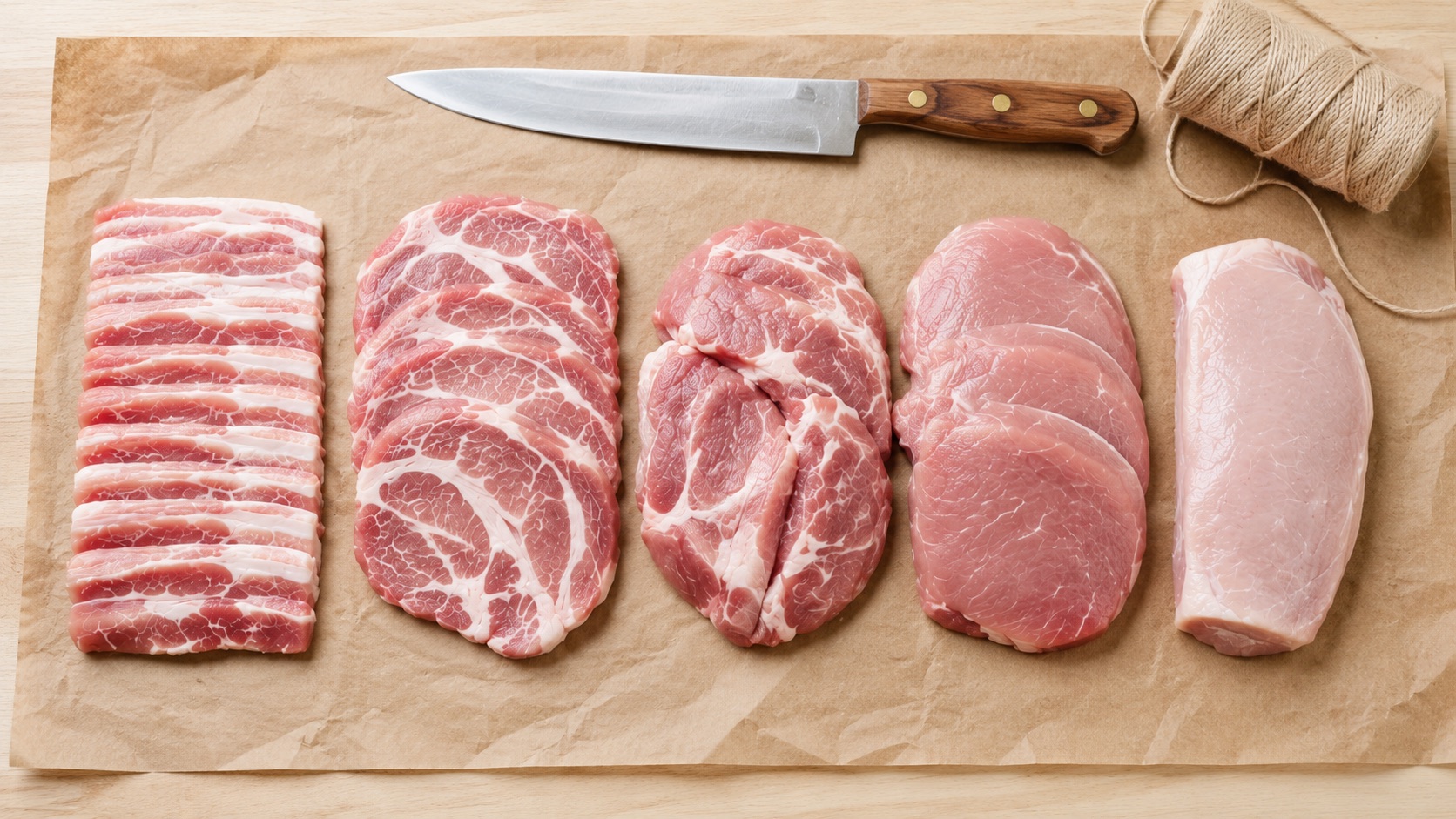
- Grilling
- If you like rich, fatty flavor, go with 삼겹살 (pork belly). For something less greasy with more meat flavor, 목심 (pork shoulder/collar) is a safe choice. 목심 also works well for thick-cut grilling.
- Boiled Pork
- 삼겹살 (pork belly) and 앞다리살 (front leg) are the most common choices. 삼겹살 is soft and fatty; 앞다리살 is relatively lean with a deeper meat flavor.
- Stir-fried Pork
- 앞다리살 (front leg) and 뒷다리살 (hind leg) are widely used. Thinly sliced and seasoned, they're great for quick stir-frying and relatively affordable.
- Tonkatsu & Braised
- Tonkatsu (pork cutlet) typically uses 등심 (loin) or 안심 (tenderloin). Soy-braised pork (장조림) usually uses lean cuts like 뒷다리살 (hind leg).
What to Look at First When Choosing a Cut
When picking pork, pay attention to the fat just as much as the cut name.
Some cuts like 삼겹살 (pork belly) have white fat and lean meat arranged in distinct layers. Others like 목심 (pork shoulder/collar) have fat marbled throughout the muscle. 앞다리살 (front leg) and 뒷다리살 (hind leg) are relatively lean.
This difference shows immediately on the heat. 삼겹살 (pork belly) releases plenty of oil from its fat layers, so it grills well without any added oil. 목심 (pork shoulder/collar) has fat scattered throughout the meat, keeping it moist even when cut thick.
Conversely, lean cuts can dry out and toughen quickly at high heat for extended periods. However, they work well when thinly sliced and seasoned, or cooked in broth or with moisture.
Next, consider cooking time. Some dishes like grilled 삼겹살 or stir-fried pork finish quickly, while others like boiled pork (수육) or soy-braised pork (장조림) require long cooking.
For quick grilling, cuts that are naturally tender with some fat are convenient. For long boiling or braising, tougher cuts can become tender enough with time.
Rather than asking which cut tastes best, it's actually easier to start by deciding how you'll cook it tonight.
The primal cuts of pork include 안심 (tenderloin), 등심 (loin), 목심 (pork shoulder/collar), 갈비 (ribs), 삼겹살 (pork belly), 앞다리 (front leg), and 뒷다리 (hind leg). Names you often see at restaurants like 항정살 (hang-jeong-sal) or 갈매기살 (gal-mae-gi-sal) are sub-primal cuts from finer butchering.
Cut-by-Cut Characteristics, from Belly to Ribs
삼겹살 (Pork Belly)
삼겹살 (pork belly) has lean meat and fat stacked in alternating layers. As the name suggests (삼겹 means "three layers"), the cross-section shows multiple layers of meat and fat.
The most familiar way to cook it is, of course, grilling. On heat, the fat renders naturally and the surface crisps up in its own oil.
It also works wonderfully as boiled pork (수육). Long simmering softens the fat layers and keeps the lean meat relatively moist. This is why 삼겹살 is the go-to choice for those who prefer soft, rich boiled pork.
You can add it to stews as well, though extended simmering releases fat into the broth, making it richer than stews made with 앞다리살 (front leg) or 목심 (pork shoulder/collar).
When buying 삼겹살, look at the cross-section rather than the top surface. It's easier to check whether the fat layers are excessively thick and how the lean meat and fat are distributed. Even within the same pack, individual pieces can vary slightly in fat ratio.
목심 (Pork Shoulder/Collar)
목심 (pork shoulder/collar), commonly called 목살, doesn't have a thick fat layer on one side like 삼겹살. Instead, fat is marbled throughout the lean meat. This gives it less of the oily sensation of 삼겹살 while avoiding toughness.
This is why it's popular for grilling. You can slice it about 1cm thick for standard grilling, or cut it 2cm thick and cook it steak-style. The intramuscular fat makes it relatively easy to handle even when cut thick.
목심 also works for stir-fried pork (제육볶음). It's slightly fattier than 앞다리살 (front leg), making it more tender, while producing less pan drippings than 삼겹살 (pork belly).
It's a solid choice for kimchi stew too. The broth is less greasy than with 삼겹살, yet retains the distinctive meat flavor of 목심. If 삼겹살 feels too greasy for grilling, 목심 is a good place to start.
앞다리살 (Front Leg)
앞다리살 (front leg) is one of the most versatile cuts. It has less fat than 삼겹살 or 목심, but it's not purely lean either. The distribution of muscle and fat varies even within a single piece.
Thinly sliced 앞다리살 is widely used for stir-fried pork (제육볶음) and pork bulgogi. It's great for quick cooking over high heat with seasoning.
Bought as a whole piece, it can also be used for boiled pork (수육). Compared to 삼겹살 boiled pork, it's leaner and has a firmer, meatier chew. Many people choose 앞다리살 when they find fatty boiled pork too heavy.
It works well in stews too. In kimchi stew, it doesn't release as much oil as 삼겹살, while still contributing plenty of meat flavor.
When buying a whole piece of 앞다리살, note that the muscle grain may not run in a single direction. If you've boiled it for 수육, slice against the grain and not too thickly for the best texture. Considering both price and versatility, it's one of the most practical cuts for home cooking.
뒷다리살 (Hind Leg)
뒷다리살 (hind leg) has a high proportion of lean meat. Because it's low in fat, it's not commonly used for thick-cut grilling like 삼겹살 or 목심. It can become tough if grilled too long.
However, it pairs well with dishes where the meat is thinly sliced and seasoned. In pork bulgogi or stir-fried pork (제육볶음), seasoning and quick cooking help offset its leanness.
It's also commonly used for soy-braised pork (장조림). The low fat content means less oil floating on the braising liquid, and the meat stays lean and clean-tasting.
Multiple sub-cuts come from the hind leg area, so the grain and appearance may vary between products. The yield per pig is relatively large and the price tends to be lower than 삼겹살 or 목심, making it a good choice when you need a larger quantity for dishes like stir-fried pork.
등심 (Loin)
등심 (loin) is a lean-meat-dominant cut that runs along the back. It has moderate fat, a relatively uniform shape, and slices evenly — which is why it's the go-to cut for pork tonkatsu (돈가스).
Sliced thick and pounded flat, it makes a generous tonkatsu cutlet. Diced, it works for sweet and sour pork (탕수육) as well.
Being lean, it can turn tough if overcooked. It can be grilled, but unlike 삼겹살, it's best eaten as soon as it's done rather than left on the grill for an extended time.
At grocery stores, 등심 is often sold pre-sliced for specific uses like tonkatsu or japchae (glass noodle stir-fry).
안심 (Tenderloin)
안심 (tenderloin) comes in small quantities from each pig. It has a tender grain with little fat, and is used for tenderloin tonkatsu and sweet and sour pork. It's smaller and more elongated than 등심 (loin).
Like 등심, it's tender but lean. Overcooking causes moisture loss and a noticeable drop in texture.
When grilling a thick-cut tenderloin, it's better to sear the surface and cook the interior only as much as needed, rather than grilling on high heat for a long time.
Many restaurants sell loin tonkatsu and tenderloin tonkatsu separately — the two cuts differ in size and texture.
갈비 (Ribs)
갈비 (ribs) is the meat around the rib bones. Many products are sold bone-in, which gives them a distinctly different appearance from other cuts. They're commonly used in braised ribs (갈비찜) and back ribs (등갈비) — dishes where the meat is cooked on the bone.
When thick ribs are cooked for a long time, the meat around the bones becomes tender and falls off easily.
등갈비 (back ribs) are eaten by tearing the meat off along the rib bones. Some products are sold with the bone removed as 갈비살 (boneless rib meat).
When buying 갈비, check whether the listed weight includes the bone. Two packages weighing the same 1kg can yield very different amounts of edible meat depending on whether bones are included.
항정살 (Jowl) and 갈매기살 (Skirt Meat)
항정살 and 갈매기살 are sub-primal cuts rather than major primal sections like 삼겹살.
항정살 comes from around the neck and has fat finely interspersed throughout. It has a distinctive chewy-yet-fatty texture when grilled, making it a popular grilling cut.
갈매기살 comes from around the diaphragm. Despite the name (which sounds like "seagull" in Korean), it's a pork cut.
Both yield only a small amount per pig, so they tend to be pricier than 삼겹살 or 앞다리살. They're almost exclusively sold for grilling — it's uncommon to buy them specifically for soups or stews.
In the simplest terms, think of pork in three groups: cuts with distinct fat layers like 삼겹살 (pork belly), cuts with fat marbled throughout like 목심 (pork shoulder/collar), and cuts with mostly lean meat like 앞다리살 (front leg) and 뒷다리살 (hind leg). That makes choosing a bit easier.
Which Cuts Work for Stews and Stir-fries
The biggest difference between grilling and stewing is where the rendered fat ends up. When you grill 삼겹살 (pork belly), the fat drips off and stays on the grill. In a stew, that fat goes straight into the broth.
If you want a rich, oily kimchi stew, 삼겹살 works well. If you'd rather have less oil floating on the surface, switch to 앞다리살 (front leg) or 목심 (pork shoulder/collar). You'll still get meat flavor with less fat in the broth.
Stir-fried pork (제육볶음) is a different story. Since it's a quick, high-heat dish with seasoned meat, using very fatty cuts like 삼겹살 can leave too much oil in the pan.
Some people like 삼겹살 제육, and that's fine. But 앞다리살 (front leg) or 뒷다리살 (hind leg) — with their higher lean-to-fat ratio — are more commonly used. Using 목심 gives a slightly softer, fattier result than 앞다리살. Even for a single dish like stir-fried pork, you can adjust the flavor by switching cuts.
For slow-simmered dishes like soy-braised pork (장조림), lean cuts are more practical. 뒷다리살 (hind leg) or 안심 (tenderloin) leave less solidified fat on the surface after cooling.
That said, broth-based dishes don't always require lean cuts. In pork kimchi stew, the fat released from the meat is part of the flavor itself. The choice comes down to whether you want a rich or a clean taste — and that can change even for the same dish.
Start with the Dish, Then Pick the Cut
You don't need to agonize over cuts at the store. If you've already decided what to cook, working backwards is the fastest approach.
| Dish | Cut to Look at First | Selection Tips |
|---|---|---|
| Grilled 삼겹살 (Pork Belly) | 삼겹살 (Pork Belly) | Check the fat-to-lean ratio and thickness |
| Grilled 목살 (Pork Shoulder) | 목심 (Pork Shoulder/Collar) | Stays moist even when cut thick |
| Boiled Pork (수육) & Bossam | 삼겹살, 앞다리살 | 삼겹살 for richness, 앞다리살 for a leaner taste |
| Kimchi Stew (김치찌개) | 앞다리살, 목심, 삼겹살 | Choose based on how oily you want the broth |
| Stir-fried Pork (제육볶음) | 앞다리살, 뒷다리살, 목심 | Pre-sliced thin products are most convenient |
| Pork Bulgogi (돼지불고기) | 앞다리살, 뒷다리살 | Choose thinly sliced products |
| Tonkatsu (돈가스) | 등심 (Loin), 안심 (Tenderloin) | 등심 is wider; 안심 is smaller and more tender |
| Sweet & Sour Pork (탕수육) | 등심, 안심, 앞다리살 | Choose cuts easy to dice into uniform pieces |
| Soy-braised Pork (장조림) | 뒷다리살, 안심 | Lean whole pieces are most practical |
| Braised Ribs (갈비찜) | 갈비 (Ribs) | Check whether the weight includes bones |
These pairings aren't the only correct answers. Many households put 삼겹살 in kimchi stew, use 목심 or 삼겹살 for stir-fried pork, and choose between 등심 and 안심 tonkatsu based on personal texture preference. If it's your first time making a dish, start with the most commonly used cut, then adjust for fat level and texture next time.
Same Cut, Different Prep — It Matters
Buying a pack of 앞다리살 (front leg) doesn't mean it's ready for any recipe. The same cut sliced thin versus sold as a whole chunk serves completely different purposes.
This is why packages label usage alongside the cut name: grilling, bulgogi, stew, or boiled pork. These labels aren't just menu suggestions — they're information about the size and thickness the meat has been prepared to.
Bulgogi-style packs are thinly sliced, stew-style packs are cut into bite-sized pieces, boiled pork is sold as whole blocks, and grilling cuts are sliced to a thickness suitable for the grill.
Rather than grabbing a cut you like right away, also check the intended use on the label. You can buy boiled-pork-style 앞다리살 and make stir-fried pork from it, but you'll need to slice it thin yourself. On the other hand, it's impractical to make boiled pork from already thinly sliced bulgogi-style 앞다리살.
If the butcher counter offers custom slicing, the simplest approach is to just say what you're cooking. Tell them you want 앞다리살 sliced for stir-fried pork, or that you need a piece for boiled pork that isn't too fatty, and they'll usually prep it accordingly.
Why Prices Differ Between Cuts
Even though all cuts come from the same pig, 삼겹살 (pork belly) and 뒷다리살 (hind leg) can differ significantly in price. Each cut yields a different amount per pig, and consumer demand varies.
In Korea, 삼겹살 and 목심 are heavily sought after for grilling. Steady demand combined with limited yield per pig means they tend to cost more than other cuts.
Meanwhile, 앞다리살 (front leg) and 뒷다리살 (hind leg) yield more per pig and aren't as concentrated in demand for grilling. So for seasoned dishes like stir-fried pork or bulgogi, there's no need to use 삼겹살. Choosing 앞다리살 or 뒷다리살 makes it easier to get more for the same budget.
The same applies to boiled pork. If you love soft, fatty boiled pork, 삼겹살 is the natural choice. But if you prefer something leaner or need to prepare a larger serving for many people, it's worth comparing 앞다리살.
A lower price doesn't mean lower quality meat. 뒷다리살 costs less than 삼겹살 because it's less preferred for grilling and has higher supply. When used in suitable dishes like stir-fried pork or soy-braised pork, it's an excellent ingredient.
Prices also fluctuate by season and retailer. During vacation and camping seasons when demand for 삼겹살 and 목심 spikes, price gaps can widen depending on promotions. Meanwhile, 앞다리살 and 뒷다리살 tend to have less noticeable price swings.
If you want to reduce your grocery bill, switching to a different cut suited to your dish can be more effective than hunting for the cheapest option within the same cut.
That said, substituting cuts works mainly for seasoned or long-cooked dishes. Grilling is different. Swapping 삼겹살 for 뒷다리살 lowers the cost but produces an entirely different dish.
For grilling, instead of switching cuts, compare thickness, preparation, and price per 100g within the same cut. Even for the same 삼겹살, products vary in slice thickness and package size, leaving plenty to compare.
Frequently Asked Questions
They generally refer to the same cut. The official primal cut name is 목심 (mok-sim), while restaurants and grocery stores commonly use 목살 (mok-sal). Depending on the product, it may be labeled as either 돼지 목심 or 목살.
Both have a higher proportion of lean meat compared to 삼겹살 (pork belly) or 목심 (pork shoulder/collar), but 앞다리살 (front leg) has slightly more fat marbled throughout. It works well in a variety of dishes like stir-fried pork, stews, and boiled pork. 뒷다리살 (hind leg) is leaner and is often used for bulgogi, soy-braised pork, and stir-fried pork.
It depends on the texture you prefer. If you enjoy soft, well-rendered fat in your boiled pork, 삼겹살 is a good fit. If you want a meatier, leaner boiled pork, 앞다리살 works well. When serving a group, it's common to boil both cuts together.
Both are sub-primal cuts taken from finer butchering of the pig. 항정살 comes from around the neck, and 갈매기살 from around the diaphragm. The yield per pig is small, and they are mostly sold for grilling.
Absolutely. However, grilling cuts are often sliced wide and thick, so it's best to cut them into bite-sized pieces before adding to a stew. Conversely, very thinly sliced bulgogi-style meat can lose its shape if simmered too long.
The criteria for choosing the right cut are the same. However, since moisture can escape during the freezing and thawing process, it's best not to overcook lean cuts when grilling. For dishes that use seasoning or broth — such as stir-fried pork, bulgogi, or stews — frozen pork works perfectly fine.
It varies by product. 앞다리살 (front leg) or 뒷다리살 (hind leg) are commonly used, and sometimes multiple cuts are blended to achieve a desired fat ratio. When buying ground pork, it's better to check the ingredient list, fat percentage, and country of origin rather than just going by the label.
In fact, that's exactly what many people do when grilling for a group. 삼겹살 is fattier while 목심 is relatively leaner, so alternating between them adds variety. If you're feeding a crowd, try preparing half 삼겹살 and half 목심, then see which one runs out first — it can help plan your next shopping trip.
- Korea Law Information Center — MFDS labeling standards and cut classification for beef and pork
- Korea Institute for Animal Products Quality Evaluation — Livestock cut and grading guidelines