Pork comes in all kinds of pack weights, so the marked price alone is hard to compare. To compare 400g, 500g and 1kg products, first convert them to the price per 100g.
But even for the same pork belly, whether it is chilled or frozen, the thickness, the trimming and whether bone is included can all differ. The price per 100g is most useful when comparing products under similar conditions.
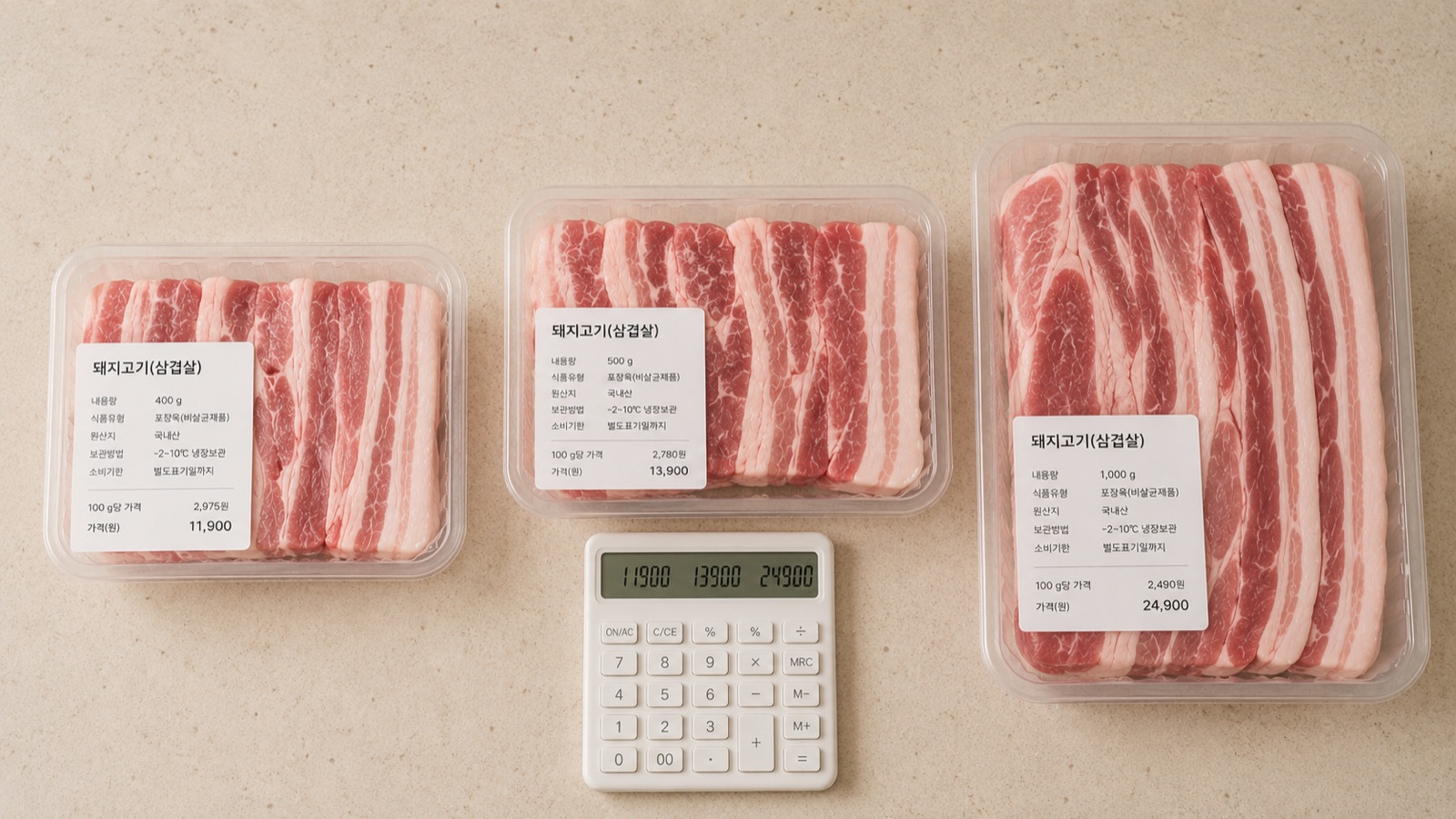
- Compare prices on a 100g basis
- Calculate with price ÷ weight × 100.
- What to check alongside
- Whether it is the same cut, whether it is chilled or frozen, whether bone is included, and whether the thickness and trimming are similar.
- Online, include the delivery fee
- When you are buying only one or two packs, including the delivery fee can change the order.
- Discounted products
- To compare what you would pay now, use the selling price; to compare usual prices, look at the list price as well.
Calculating the price per 100g
The formula is simple.
Price ÷ weight in grams × 100
For example, pork belly at 16,200 won for 500g is 3,240 won per 100g.
At 13,600 won for 400g it is 3,400 won per 100g, and at 24,900 won for 1kg it is 2,490 won.
| Product | Weight | Price | Price per 100g |
|---|---|---|---|
| A | 400g | 13,600 won | 3,400 won |
| B | 500g | 16,200 won | 3,240 won |
| C | 1kg | 24,900 won | 2,490 won |
Converted this way, products with different pack sizes can be compared on the same basis.
That said, comparing within the same cut is the basic rule. Pork belly and front leg are different cuts, so putting their unit prices side by side means little.
When the unit prices are similar, look at the specification
If the price per 100g is similar between products, check the following conditions.
Chilled or frozen
Chilled and frozen differ in how they are stored and how they are used.
If you are looking for something to grill right away, compare chilled products with each other; if you are looking for something to keep for a long time, compare frozen products with each other.
Whether the thickness is the same
Pork belly for grilling is cut to widely different thicknesses even within the same cut.
Comparing a thinly sliced product at around 10mm with a thick one at around 20mm on unit price alone can leave you with something that does not suit your use.
When thickness matters, first check whether the product name or the detail information states mm or cm.
Whether bone is included
Products with bone attached, such as back ribs or pork ribs, include the weight of the bone in the stated weight.
So comparing boneless meat and bone-in meat on price per 100g alone leaves a difference in the amount of lean you actually eat.
Whether the trimming is the same
A whole piece, meat sliced for grilling, a scored product and marinated meat are hard to treat as the same condition.
When comparing unit prices, put products with a similar cut and a similar form of trimming side by side where you can.
Treat discounted prices separately
If a 500g product with a list price of 16,000 won is on sale at 13,000 won, the current price per 100g is 2,600 won.
On a list price basis it is 3,200 won.
If it is a product you are buying once now, calculate with the current selling price. If your purpose is to compare the usual price levels of several brands, it is better to record the list price as well.
Online shops in particular attach conditions such as coupons, member prices and card discounts, so you have to work from the price you actually pay.
Online, include the delivery fee
Online, comparing only the product price can leave a gap against the amount you actually pay.
For example, if 500g of pork belly is 13,000 won and the delivery fee is 3,000 won, buying a single pack costs 16,000 won in total.
In that case the effective cost including delivery is 3,200 won per 100g.
Conversely, ordering several packs at once or passing the free delivery threshold reduces the effect of the delivery fee.
So when comparing online prices, it is more accurate to decide how many packs you will buy and compare the final payment amount.
This is the order to compare in
Select products under the same conditions first, then compare the prices.
- Cut
- Chilled or frozen
- Thickness and trimming
- Whether bone is included
- Price per 100g
If you are looking for pork belly for camping, for instance, you set the conditions of chilled pork belly at around 2cm first and compare the price per 100g within that.
Do it the other way around, looking for the cheapest pork belly first and checking the specification later, and products that do not suit your use get into the comparison.
If the price gap is small, look at the pack size too
Even at a slightly lower price per 100g, buying more than you need means storing the meat that is left.
There is no need to choose a large pack just because the 1kg product is cheapest when two people are eating. Conversely, when several people are eating, a large pack can be easier than buying several 400g packs.
So in the end it is better to decide the amount you need first and compare unit prices within that range.
Frequently asked questions
Divide the price by the weight and multiply by 100. At 16,200 won for 500g it is 3,240 won per 100g.
Not necessarily. Even a large pack can have a higher price per 100g depending on the brand, the cut and whether it is discounted. You have to convert and compare for yourself.
If you are comparing what you would pay now, calculate with the selling price. If your purpose is to compare usual prices, look at the list price as well.
You can compare the prices themselves, but the storage method and the intended use differ. For a comparison aimed at an actual purchase, it is better to look within the same storage form.
The calculation is possible, but you have to take into account that the weight of the bone is included. Compared with a boneless product, the amount you can actually eat is not the same.
It is not entirely meaningless. But for a use where thickness matters, such as grilling, it is better to decide the thickness you want first and compare prices within that condition.