When buying pork, you'll occasionally see names like Duroc, Berkshire, or YLD printed on the package. It's easy to pass over them when you normally just check the cut, weight, and origin — but when these labels do appear, you can't help wondering what makes the product different.
The problem is that these names don't all represent the same type of information. Duroc and Berkshire are breed names, while LYD and YLD refer to crossbreeding combinations of multiple breeds. On top of that, some brands attach their own proprietary line names. They look similar on the package, but they point to different things.
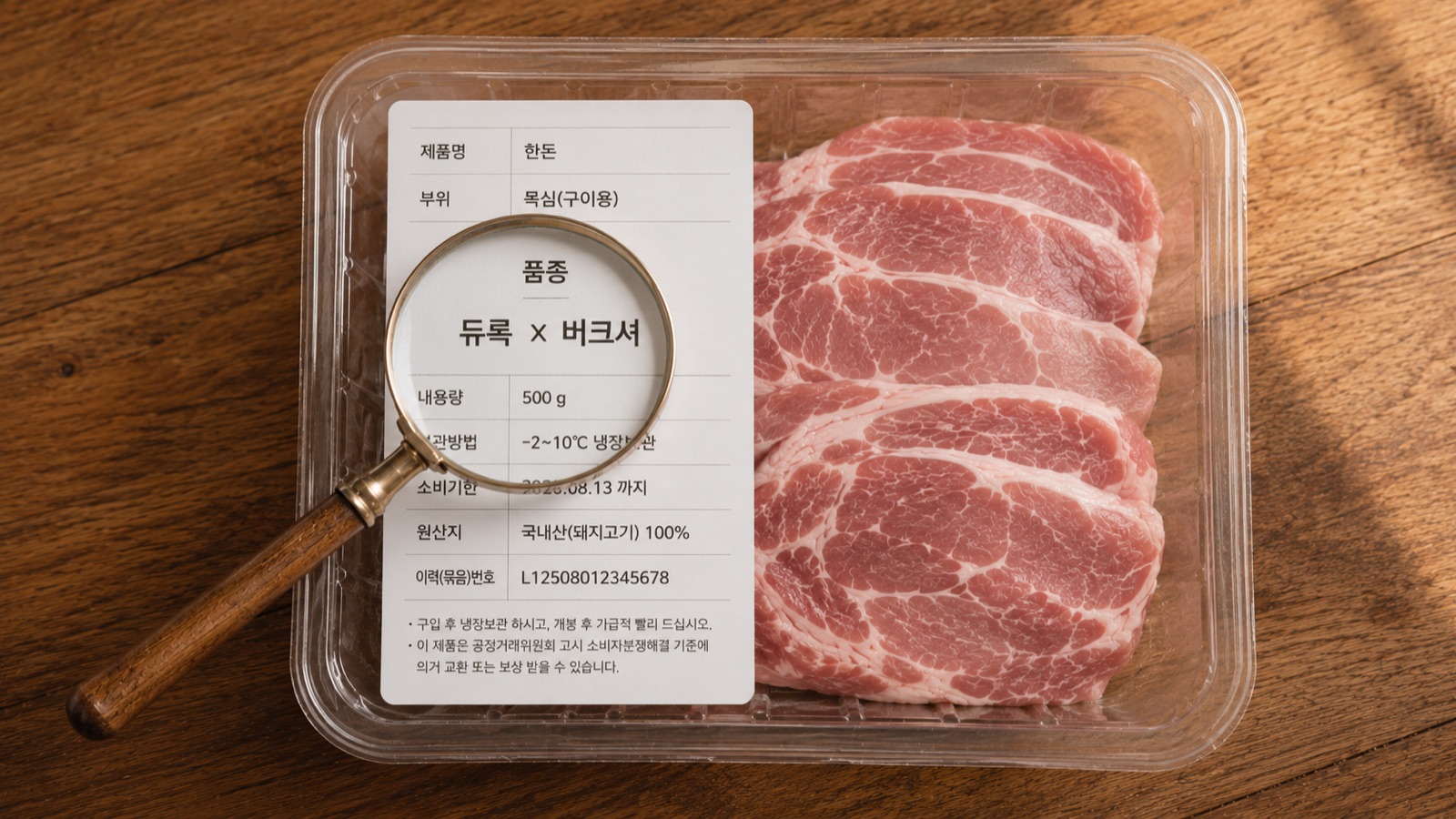
- Breed Names
- Duroc, Berkshire, Yorkshire, and Landrace are breed names for pigs. They are among the most commonly used breeds for breeding stock.
- Crossbred Codes
- LYD and YLD are expressions describing three-way crossbred pigs combining Landrace, Yorkshire, and Duroc.
- Brand Lines
- Names given by specific companies or farms that select and manage their own breeding stock over generations. These are different in nature from breed names.
- No Label?
- The absence of a breed label doesn't mean the meat is inferior. Breed information is not always displayed on packaged pork.
Why Breed Labels Appear on Some Products Only
Browse the meat section at a grocery store and you'll notice most pork packages prominently display the cut name (삼겹살, 목심, etc.), weight, origin, and price. Products with breed names like Duroc or Berkshire printed prominently are relatively uncommon.
These labels tend to appear when a brand uses a specific breed or line as a selling point. Conversely, plenty of standard packaged pork doesn't feature any breed name at all.
A prominent breed name on the package doesn't inherently indicate higher or lower quality. It's better to read it simply as the product highlighting its breed, crossbreeding method, or proprietary line as one of its characteristics.
Many products also include a traceability number on the package. This number lets you look up information related to farming and slaughter, but the consumer lookup interface doesn't necessarily show detailed breed composition for every product.
So if you're curious about the breed, don't just look at the name on the front — it's more accurate to also check the product detail page or the brand's published descriptions.
When you see Duroc, Berkshire, "black pig," or an unfamiliar English abbreviation printed prominently, start by confirming what that name actually refers to. Even on the same pork package, it could be a breed name, a crossbreeding combination, or a proprietary line name assigned by the brand.
Three-Way Crossbreeding: The Standard Behind Most Pork
The pork we eat doesn't necessarily come from raising a single breed. Commercially farmed pigs are often crossbred to combine the strengths of different breeds. In Korea, three-way crosses using Landrace, Yorkshire, and Duroc are widely established.
The most common notation you'll see is LYD or YLD. Each letter comes from the English name of the breed.
Typically, Landrace and Yorkshire are used on the maternal side, and Duroc is crossed in as the sire.
Landrace and Yorkshire are used for their reproductive ability and maternal traits, while Duroc is commonly used on the paternal side for growth performance and meat quality traits. Actual breeding schemes may vary by breeding stock company and production system.
If you come across LYD or YLD in pork-related material, it refers to this three-way crossbreeding structure.
An important point: this does not mean the pork is 100% Duroc. The market hog carries genetic contributions from all three breeds, with Duroc being one component.
So even if "Duroc" appears prominently on the package, you should check further to determine whether it's purebred Duroc, a product using Duroc in its crossbreeding, or a brand product emphasizing a Duroc line.
Landrace, Yorkshire, Duroc, and Berkshire
These are the breeds you'll most commonly encounter in pork-related descriptions.
Landrace
Landrace is a white pig known to have been developed in Denmark. It's often described as having ears that droop forward, and in commercial pig production it's widely used as a maternal breed.
With a relatively long body and traits suited for reproduction and mothering, it's frequently paired with Yorkshire to create the dam line.
Consumers won't often see "Landrace 삼겹살" at the meat counter, but Landrace appears frequently in materials explaining pig crossbreeding structures. It's one of the foundational breeds behind the pork we eat.
Yorkshire
Yorkshire is a white pig developed in England, sometimes referred to as Large White in different sources. Like Landrace, it's used on the maternal side for its reproductive ability and mothering traits.
The well-known three-way cross involves breeding a Landrace × Yorkshire sow, then crossing her with a Duroc boar.
If you see the letter Y in an abbreviation on a pork package, it usually stands for Yorkshire. That said, if only a single-letter abbreviation appears on a product, it's safer to verify what it means through the manufacturer or brand description.
Duroc
Duroc is a breed known for its reddish-brown coat. Among breed names you'll see on pork products, it's one of the more frequently highlighted.
In commercial crossbreeding, Duroc is commonly used on the paternal side and is often mentioned in connection with growth performance, intramuscular fat, and other meat quality traits. Some brands emphasize the proportion of Duroc or their Duroc line as a product differentiator.
However, the name "Duroc" on the label alone doesn't guarantee tenderer or tastier meat. Even within the same Duroc line, the final product varies depending on farming conditions, feed, shipping age, fat levels, post-slaughter processing, and aging. It's also important to distinguish whether the product uses purebred Duroc or a Duroc-sired crossbred pig.
So when you see the word Duroc, don't stop there — it's worth checking how much detail the product description provides.
Berkshire
Berkshire is a breed of black pig known to have originated in England. Unlike Landrace, Yorkshire, and Duroc — which form the standard trio in three-way cross descriptions — Berkshire occupies a somewhat different position in consumer awareness.
In Korea, the name Berkshire appears in connection with black pigs (흑돼지) and certain premium pork brands. Some products emphasize purebred Berkshire, while others use Berkshire crossed with other breeds.
Just because a package says Berkshire doesn't mean all such products share the same composition. If the brand separately explains purebred status, crossbreeding method, or farming practices, that information should be checked alongside the label.
| Breed | Known Origin | Typical Coat Color | Common Role in Commercial Crossbreeding |
|---|---|---|---|
| Landrace | Denmark | White | Maternal |
| Yorkshire | England | White | Maternal |
| Duroc | United States | Reddish-brown | Paternal |
| Berkshire | England | Black | Black pig and specialty products |
This table is for understanding basic breed characteristics. Pigs of the same breed don't all exhibit identical traits across every farm. Differences arise based on breeding stock selection and farming practices. Breed names are best understood as a starting point for knowing a pig's genetic background.
Is "Black Pig" a Breed Name?
"Black pig" (흑돼지) shouldn't be read as equivalent to a single breed name like Berkshire. It's used as a broad term for pigs with dark hair, which means various breeds and lines can fall under the "black pig" umbrella.
Some black pigs use Berkshire lineage, some are related to Korean native pig lines, and others are crossbred products from multiple breeds. So when a package simply says "black pig," the name alone doesn't reveal the exact breed composition.
Jeju black pig (제주 흑돼지) is a similar case. The regional and product context of black pigs raised in Jeju, and the actual breed or crossbreeding lineage, need to be checked separately. Even among products labeled as Jeju black pork, the lines and production methods used by different farms and brands cannot be assumed to be identical.
If you're curious about the breed, it's better to look beyond the broad label of "black pig" and check whether there's a description of the specific breed or line used. If the product detail page mentions Berkshire, native breed, crossbred, or similar terms, that's where you'll find more specific information.
Brand-Managed Lines
Some pork brands attach a distinctive proprietary name that differs from standard breed names. This happens when a company selects specific breeding stock, manages them over multiple generations, or operates a production system targeting desired traits and assigns its own line or brand name.
These names may not be the same type of label as breed names like Duroc or Berkshire. Duroc and Berkshire refer to breeds, while a brand line may refer to a production system built on existing breeds or crossbreeding combinations managed by a specific company.
If an unfamiliar line name appears prominently on a package, read the description rather than just the name. Brands that disclose what breed the line is based on, how they select breeding stock, and how their product differs from standard ones — those give you enough to understand what the name means. If there's no explanation, the label alone doesn't tell you much.
For example, one product might emphasize Duroc as a breed, while another highlights a proprietary line name managed by the brand. Even if both names appear at similar sizes on the front of the package, they are not comparable on the same terms.
When comparing products, start by distinguishing whether a name refers to a breed, a crossbreeding combination, or a brand line.
How Far Should You Read into Breed Labels?
Breed information isn't meaningless. It helps you understand a pig's genetic background and what characteristics a brand is highlighting.
Products emphasizing a Duroc line often spotlight growth and meat quality traits. Products featuring Berkshire may describe the distinctive characteristics of black pig lineage or meat quality.
That said, a single breed name can't determine how the meat will actually taste. Many factors beyond breed affect the final product. Even within the same breed, feed, raising period, shipping weight, post-slaughter cooling and aging, and fat amount and distribution can all change the outcome. And obviously, 삼겹살 (pork belly) and 등심 (loin) from the same pig taste completely different.
In practice, there's information that's easier to check before breed: which cut it is, how many grams, how thickly it's sliced, and what the price per 100g is.
If you're looking for grilling meat for camping, thickness might matter more than breed. If you're making stir-fried pork, whether it's 삼겹살 or 앞다리살 (front leg) makes a bigger difference. Breed is information you look at after confirming these basics.
When a product discloses what breed was used and how, it gives you something to compare against other products.
If purebred status, crossbreeding method, and farming practices are all described in detail, that product provides more checkable data points. A brand that reveals which breed was used in which role and what difference it makes has given the consumer evidence for comparison. Conversely, a name with no explanation behind it doesn't offer much to work with.
When comparing between brands, also check whether you're comparing the same type of label. If one side is talking about a purebred and the other about a proprietary brand line, their starting points are different.
Breed labels are less a dividing line between good and bad meat, and more a window into what kind of pig the product is built on — something worth looking through when you want to know more.
Frequently Asked Questions
Both are expressions used to describe three-way crossbreeding using Landrace, Yorkshire, and Duroc. The first letters L and Y stand for Landrace and Yorkshire, and the final D stands for Duroc. The order of notation and actual crossbreeding configuration can vary slightly by source and production system, so for a specific product, it's most accurate to check that brand's own description.
In commercial pork production, crossbreeding is widely used to combine the advantages of multiple breeds. It's more efficient to combine different breeds for reproductive ability, growth rate, and carcass traits rather than trying to achieve everything with a single breed. As a result, products prominently featuring a specific purebred name are relatively uncommon in general retail.
A breed name alone doesn't guarantee better flavor. Duroc is commonly used in commercial crossbreeding for its meat quality traits, but actual taste and texture are also influenced by the cut, fat content, feeding regimen, aging, and cooking method. If a product emphasizes Duroc, it's worth checking how exactly Duroc was used in its production.
They are not the same. Berkshire is a specific breed name, while "black pig" (흑돼지) is a broad term for pigs with dark hair. Berkshire can be classified as a black pig, but not every product labeled "black pig" is Berkshire.
The name "Jeju black pig" alone doesn't mean all products share the same breed or crossbreeding lineage. The lines and farming practices used can differ by farm and brand. If you're curious about the exact breed, it's best to check the information published by the producer or brand.
With standard packaging information alone, it's often difficult to determine the specific breed or crossbreeding combination. Some information can be looked up via the livestock traceability number, but not all products provide detailed breed composition through the consumer lookup interface. If breed matters to you, the simplest approach is to choose brands or products that voluntarily disclose this information.
No. Breed refers to the pig's genetic background, while grade is the result of evaluating the carcass after slaughter according to standardized criteria. Pigs of the same breed can receive different grades depending on the individual animal.
Yes, crossbreeding with Landrace, Yorkshire, Duroc, and other breeds is widely practiced in commercial pork production around the world. However, the specific breeds and combinations vary by country, breeding company, and production system. When buying imported pork, if breed information isn't separately disclosed, it's more practical to first check what's readily available on the package: country of origin, cut, chilled vs. frozen, weight, and price.
- National Institute of Animal Science (Korea) — Pig breed and crossbreeding resources
- Korea Institute for Animal Products Quality Evaluation — Livestock grading guidelines
- Livestock Traceability System (Korea) — Information available via traceability number lookup