When buying pork belly or pork shoulder, the trickiest part is figuring out the right amount. A single pack seems like enough for two people, but once you hit four, it is hard to tell whether 1kg will do or if you need more.
If you are eating with rice and side dishes, starting at about 150 to 200g per adult is a safe bet. For meat-focused meals like camping trips where pork is the main event, plan for around 250g per person to have a bit extra.
In practice, though, it is hard to buy exactly the amount you calculated. A pack of pork belly might be 400g or 500g. Estimate a rough amount based on headcount, then round to whichever package size is available.
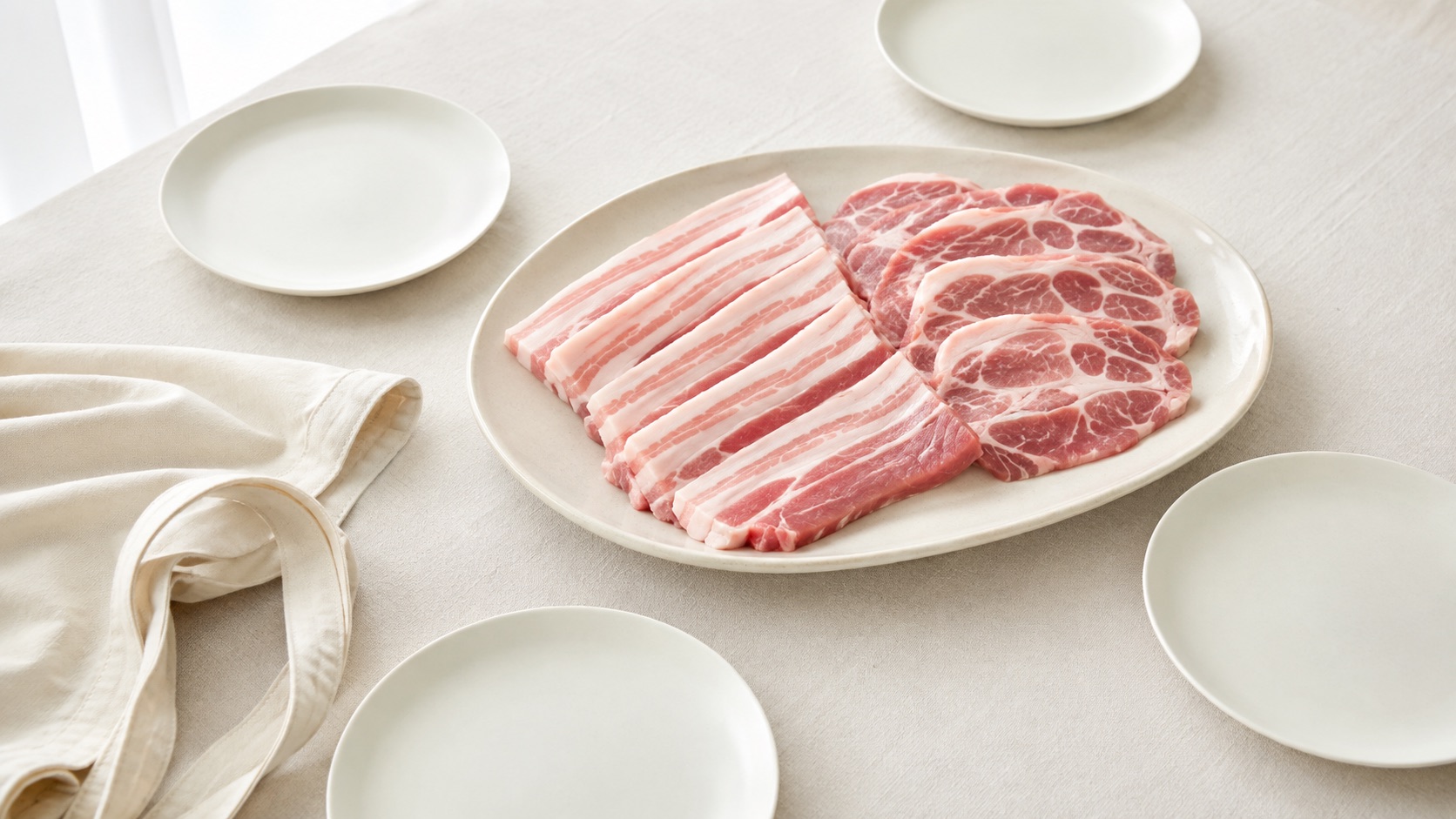
- Regular meal
- About 150 to 200g per adult. For four people, that is roughly 600 to 800g.
- Meat as the main
- For camping or meat-centric meals, plan about 200 to 250g per person for a bit extra. Heavy eaters may need more.
- With children
- Children's ages and appetites vary too much for a one-size-fits-all formula. Base it on the child's usual appetite and estimate less than an adult portion.
- Ribs & spare ribs
- Package weight includes bones. 1kg of pork belly and 1kg of spare ribs will yield different amounts of edible meat.
How many grams per serving
For a home meal with rice and side dishes, starting at about 150 to 200g of raw meat per adult makes planning easy. That means 300 to 400g for two, 600 to 800g for four.
Of course, everyone eats differently. Some people order two servings of pork belly for themselves at a restaurant, while others barely touch the meat when rice and stew are on the table.
So there is no need to treat 150g or 200g as an exact figure. It is closer to a starting point for estimating before you head to the store.
The weights mentioned here refer to raw meat before cooking. Buying 600g of pork belly does not mean you will have 600g on your plate after grilling. Moisture evaporates and fat renders out during cooking, reducing the weight.
Pork belly in particular loses a lot of fat on the grill. Even if you grill the same 500g of pork belly versus pork shoulder or a leaner cut, the perceived amount at the table can feel a bit different.
Still, there is no need to calculate post-cooking weight every time you shop. Planning by the raw weight printed on the package and matching it to your headcount is sufficient.
When meat is the main course
The amount you need differs between a home dinner with rice, soup, and side dishes, and a camping trip where meat is constantly going on the grill.
When meat is just one of several dishes, 150 to 200g per person is often plenty. But when pork is front and center, like at a campsite or barbecue, it is better to prepare more generously.
For adults, you can think about 200 to 250g per person, and for a group of heavy meat eaters, up to 300g each is not unusual. If four people are going camping, start around 800g to 1kg.
If there will be other food afterwards, like ramen, fried rice, sausages, or grilled mushrooms, you can reduce the meat. On the other hand, if the plan is to grill pork belly and pork shoulder nonstop with nothing else, preparing a bit more than 1kg will give you peace of mind.
Drinking does not necessarily mean more meat either. Individual differences are large, so rather than factoring in alcohol, it is easier to look at what else you will be eating alongside the meat to gauge the actual amount.
The same goes for children. Rather than a neat formula like "an elementary schooler eats half an adult portion," basing it on the child's usual appetite is more practical. A child who loves meat and a toddler who barely touches it cannot be counted the same way.
If your family grills pork regularly, the most accurate guide is how much was left over last time. If your family of four bought 800g and consistently had about 200g remaining, start from 600g next time.
How much for 2 to 8 people
If it is your first time buying for the group, the following ranges are a reasonable starting point.
| People | With rice & sides | Meat as main | Shopping example |
|---|---|---|---|
| 2 | 300-400g | 400-500g | One 400g or 500g pack |
| 3 | 450-600g | 600-750g | Two 300-400g packs |
| 4 | 600-800g | 800g-1kg | Two 400g or two 500g packs |
| 6 | 900g-1.2kg | 1.2-1.5kg | Two to three 500g packs |
| 8 | 1.2-1.6kg | 1.6-2kg | Three to four 500g packs |
You do not need to hit these numbers exactly. In practice, the decision usually comes down to whether to buy one more pack or not.
For example, if you calculated 800g for four people but the product you want comes in 500g packs, buying two packs gives you 1kg. That is not an unreasonable difference.
On the other hand, if you are also having rice, stew, and cold noodles, you might get by with just two 400g packs for 800g total.
If you want both pork belly and pork shoulder, you do not need to fill the entire amount with one cut. For four people, buying 500g of pork belly and 400 to 500g of pork shoulder gives you two different cuts while keeping the total around 1kg.
Pork belly, shoulder, and ribs are not the same 1kg
Even when the package weight is identical, the eating experience differs by cut.
Pork belly has a high fat content. Since much of that fat renders out during grilling, there is a noticeable difference between 500g of raw pork belly and what ends up on your plate.
Pork shoulder does not have the same thick continuous fat layers as pork belly; instead, the fat is marbled through the lean meat. So even at the same weight, pork belly and pork shoulder can feel different in volume and satiety after grilling.
The biggest difference comes with bone-in cuts. A 1kg package of spare ribs or pork ribs includes the weight of inedible bones. That is why you cannot treat 1kg of pork belly and 1kg of spare ribs as the same amount.
If ribs or spare ribs are the main dish, prepare a bit more than you would with boneless grilling cuts. Since the bone-to-meat ratio varies by product, it is hard to state a single percentage to add. Checking the product photo or the actual package to see how much meat is on the bone is the most realistic approach.
Buying a mix of cuts also works well. Instead of 1kg of pork belly alone, 500g of pork belly and 500g of pork shoulder gives you the same total weight but with variety in texture. Especially for larger groups, splitting into two cuts makes it easier to accommodate different preferences.
Fitting it to 400g, 500g, and 1kg packages
Just because you calculated 750g does not mean the store has a 750g pack of pork belly. Pre-packaged pork is typically sold in 300g, 400g, 500g, or 1kg units depending on the brand and retailer.
So in practice, you need to round your calculated amount to the nearest available package size. If you need about 800g for four people, two 400g packs hit the mark exactly. If the product you want comes in 500g packs, two packs give you 1kg.
Having an extra 200g is not necessarily a waste. At home, you can start by grilling just one pack and open the second only if you need more.
Even while camping, smaller packages can be convenient. Two 500g packs are more flexible than a single 1kg pack because you can open the second one only if the first was not enough. This is especially useful for overnight trips, since an unopened package is easier to store until the next meal.
At the butcher counter, it is even simpler. Just ask for 800g of pork belly, or 500g of pork belly and 500g of pork shoulder, and they will cut exactly what you need.
When comparing products, do not just look at the total price. Check the price per 100g as well. A 400g product may look cheaper than a 500g one, but converting to price per 100g instantly shows which is actually the better deal.
What to do with leftover meat
If you bought a generous amount, it is better not to grill everything at once. Raw leftovers are easy to use in another dish, but meat that has already been grilled tends to lose its texture when reheated.
A small amount of leftover pork belly at home can go into kimchi jjigae, fried rice, or kimchi stir-fry for the next meal. Pork shoulder and pork picnic also work well in stews and stir-fries.
When storing leftover raw meat, check the product's use-by date and recommended storage method first. Once a package is opened, conditions change from the original packaging, so if you plan to eat it several days later, freezing is often a better choice than leaving it in the refrigerator indefinitely.
Camping requires a different approach. Maintaining refrigeration outdoors is difficult, so it is best not to over-buy with the assumption that leftovers can be eaten the next day. Bringing smaller individual packs and opening them one at a time as needed makes things much easier to manage.
If you are worried about running short, preparing backup items like ramen, fried rice, mushrooms, or sausages is another practical solution.
Deciding how much pork to buy is less about buying plenty so you do not run out, and more about buying just enough so nothing goes to waste.
Start with about 150 to 200g per person, then adjust based on how much was actually left over next time for the most accurate result.
Frequently asked questions
A single 400 to 500g pack is usually enough for two people. If you are eating it with rice and stew, 400g can work. If both of you eat a lot of meat, you may need 500g or more. Rather than focusing on the package weight, it is more accurate to recall how many servings the two of you typically order at a Korean BBQ restaurant.
If meat is the main course, start thinking around 800g to 1kg. If you will also be eating ramen, fried rice, or other dishes, 800g may suffice. For four adults who eat a lot of meat, you may want to prepare 1kg or more. Splitting the purchase into two cuts, like 500g of pork belly and 500g of pork shoulder, also works well.
It depends on the fat content, thickness, and how long you grill. Fattier cuts like pork belly lose more fat during cooking, while leaner cuts may shrink relatively less. When shopping, it is simpler to plan based on the raw weight printed on the package rather than trying to calculate the cooked weight.
It is hard to decide by age alone. A child who loves meat and one who mostly eats rice and side dishes will eat very different amounts. If you know the child's usual appetite, use that as a baseline and estimate less than an adult portion. For a first-time gathering, rather than adding a full adult portion per child, it is often easier to just prepare slightly more meat overall.
Ribs and spare ribs include bone weight in the package. With 1kg of pork belly, most of it is edible meat, but 1kg of spare ribs includes a significant amount of inedible bone. For bone-in products, it is better to prepare a bit more than you would with boneless cuts like pork belly or pork shoulder for the same number of people.
Consider both the amount you need and the price. If two people want to eat without leftovers, a 400g pack may be more convenient. If you prefer a bit extra, 500g is better. When comparing prices, check the price per 100g alongside the package price to make it easier to compare products of different sizes.
For a group meal, it actually works well to prepare both. If four people will eat about 1kg total, you can split it into 500g of pork belly and 500g of pork shoulder. You get to alternate between the rich flavor of pork belly and the relatively leaner taste of pork shoulder, and it is easier to accommodate different preferences.
- Ministry of Food and Drug Safety Food poisoning prevention guidelines on meat storage and handling