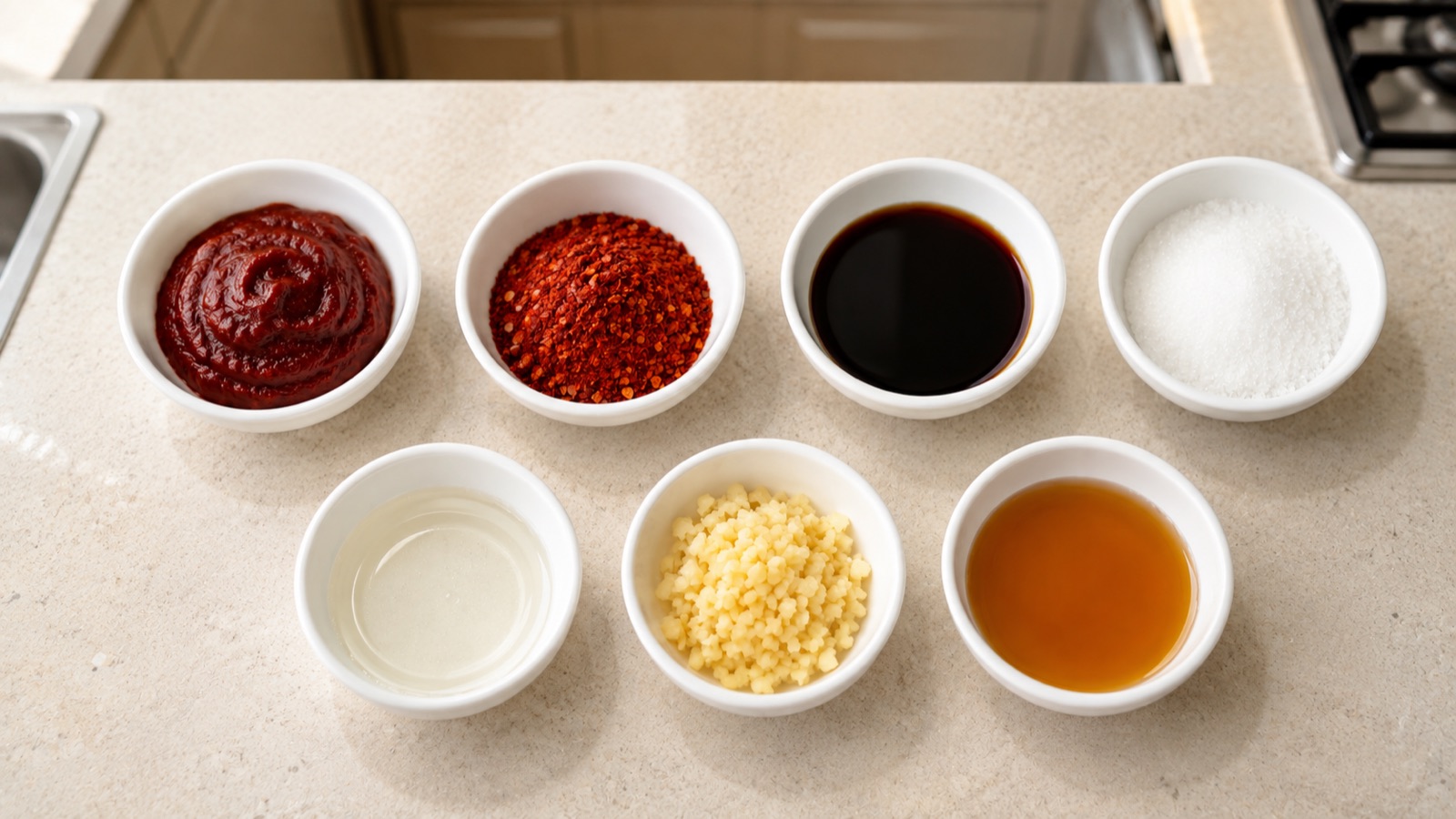
For 600g of pork shoulder stir-fried right away, start with 3 tablespoons gochujang (red pepper paste), 2 tablespoons gochugaru (red pepper flakes), 3 tablespoons soy sauce, 2 tablespoons cooking wine, 1 tablespoon sugar, 2 tablespoons oligosaccharide syrup, and 1 tablespoon minced garlic. Cook the meat first, then add the sauce and vegetables.
This ratio and sequence comes from 김진옥요리가좋다 (Kimjinok Cooking)'s diner-style 제육볶음 (jeyuk-bokkeum) recipe on 만개의레시피 (10000recipe). Below, we transcribed the steps as written and compared them with two other approaches that marinate the meat in sauce before cooking.
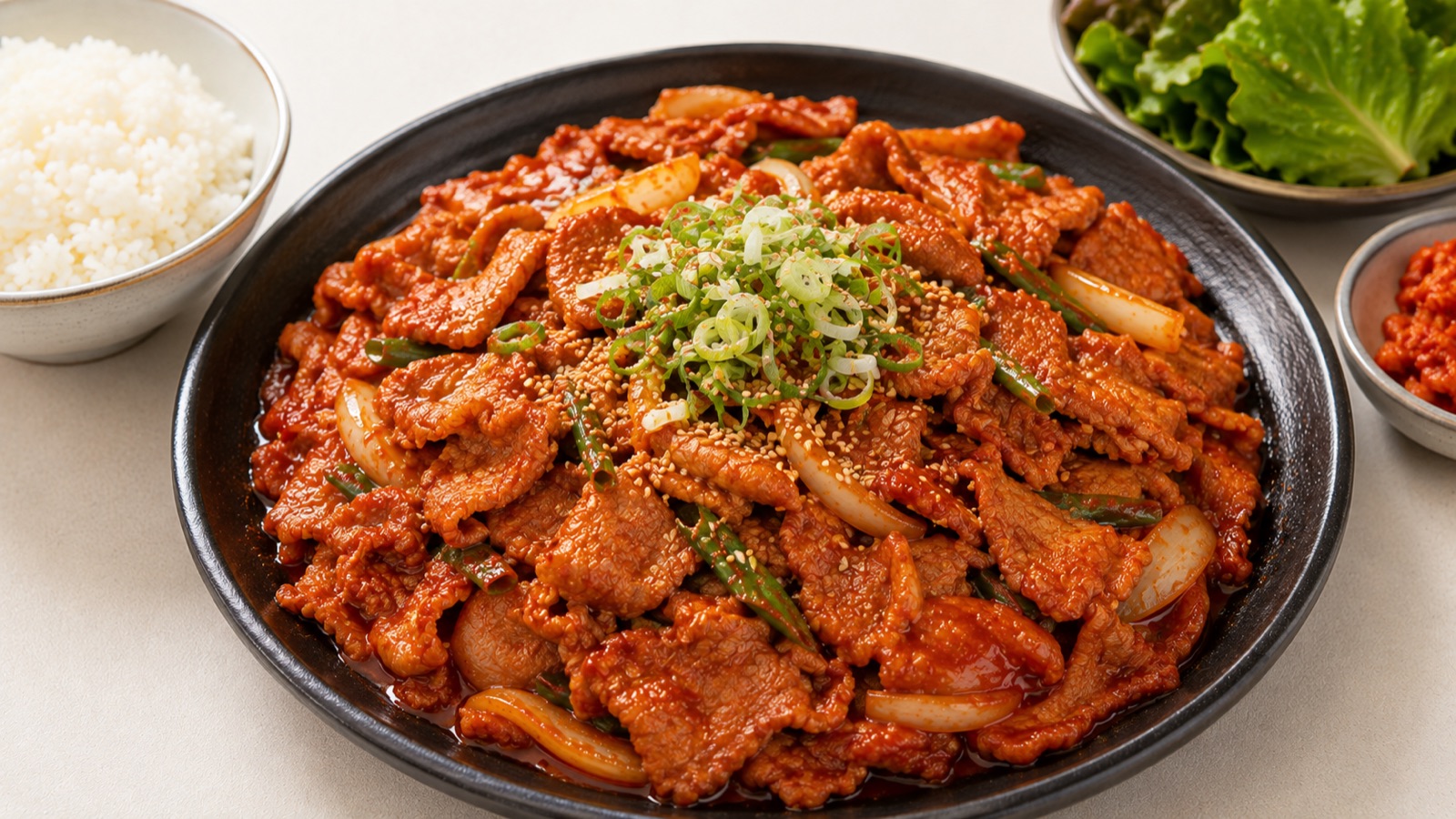
- Ingredients
- 600g pork shoulder, 1/2 onion, 2/3 green onion stalk, 1 tbsp cooking oil, 1 tbsp minced garlic
- Sauce
- 3 tbsp gochujang, 2 tbsp gochugaru, 3 tbsp soy sauce, 2 tbsp mirin, 2 tbsp oligosaccharide syrup, 1 tbsp sesame oil, 1 tbsp sesame seeds, a pinch of black pepper
- Pre-season
- 1 tbsp sugar is kept out of the sauce and tossed with the meat first.
- Order
- Cook the meat first, then add the sauce, followed by onion and green onion.
Base Recipe Step by Step
These are the steps from the 김진옥요리가좋다 (Kimjinok Cooking) recipe. It is listed as serving four.
Prep the ingredients. Place 600g of pork shoulder on a paper towel and pat off surface moisture. Slice 2/3 of a green onion stalk diagonally, and cut half an onion into 1cm-wide strips.
Make the sauce. In a bowl, combine 2 tbsp gochugaru, 2 tbsp mirin, a pinch of black pepper, 3 tbsp soy sauce, 1 tbsp sesame oil, 2 tbsp oligosaccharide syrup, 3 tbsp gochujang, and 1 tbsp sesame seeds. Do not add sugar here.
Season the meat. Add 1 tbsp cooking oil and 1 tbsp minced garlic to the pan, place the patted-dry meat on top, then add 1 tbsp sugar and toss to coat.
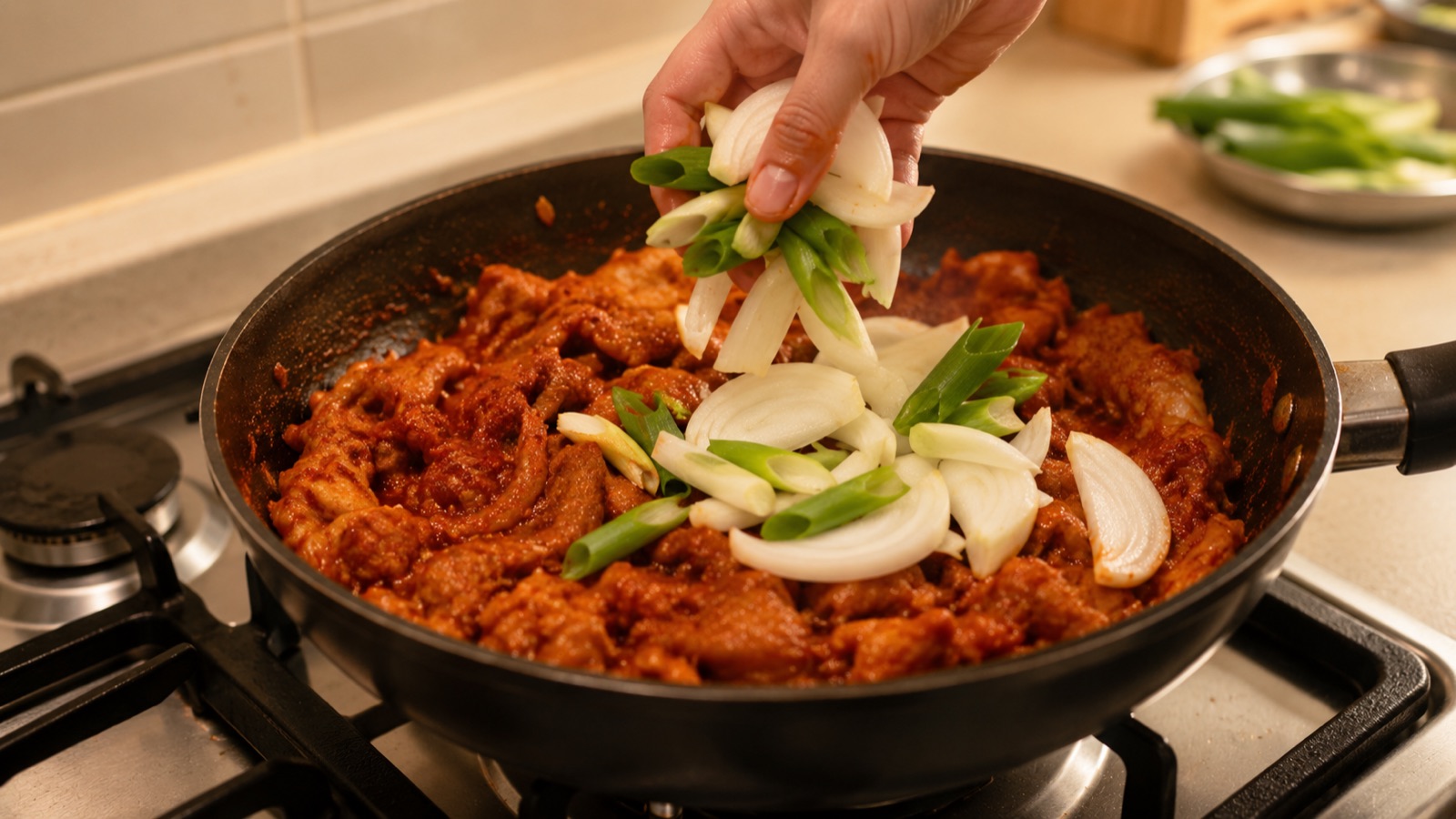
Stir-fry. Turn the heat to medium and cook until the meat is done. Once cooked, add the sauce and stir-fry until combined, then add the onion and green onion. Continue cooking until the liquid reduces to a thick glaze.
Finish. The recipe notes to taste and add more seasoning if needed.
The recipe specifies using the thinnest slices of pork shoulder available, and notes that pork jowl, pork belly, and hind leg can also be used.
The Marinate-Then-Cook Approach
Unlike the cook-first method above, some recipes toss the meat in sauce before placing it on the pan. 몽글쿡 (Monggeul Cook) and 심플민 (Simple Min) on 만개의레시피 (10000recipe) both use this approach.
몽글쿡 (Monggeul Cook)
Mix all the seasoning together, stirring until the sugar fully dissolves. Add the meat in batches rather than all at once, tossing to coat.
Instead of marinating for a long time, portion the seasoned meat and freeze it. The recipe notes that the sauce penetrates the meat during freezing.
Heat cooking oil in a pan on high, then stir-fry the thinly sliced pork shoulder while separating the pieces with chopsticks to prevent clumping.
심플민 (Simple Min)
Add sugar to the meat before any other seasoning and toss to coat. The recipe notes that sugar granules are large and need to be added first so they can absorb into the meat.
Add the remaining seasonings and mix. The recipe recommends half a day of refrigerated aging but notes that cooking immediately also works.
Heat 3 tbsp cooking oil in a pan, stir-fry green onion first to infuse the oil with its flavor, then add the meat. Because this recipe uses thick-cut pork shoulder, it was stir-fried on high heat for about 5 minutes.
Sauce Ratios Across Three Recipes
All three are based on 600g of pork shoulder. All three sources list measurements in tablespoons (T).
| Seasoning | 김진옥요리가좋다 | 몽글쿡 | 심플민 |
|---|---|---|---|
| Gochujang | 3 tbsp | 2 tbsp | 4 tbsp |
| Gochugaru | 2 tbsp | 3 tbsp | 2 tbsp |
| Soy sauce | 3 tbsp | 3 tbsp | 2 tbsp |
| Sugar | 1 tbsp | 2 tbsp | 2 tbsp |
| Oligosaccharide syrup | 2 tbsp | 1 tbsp | 1 tbsp |
| Cooking wine / mirin | 2 tbsp | 2 tbsp | 2 tbsp |
| Minced garlic | 1 tbsp | 1 tbsp | 1 tbsp |
| Sesame oil | 1 tbsp | None | 1.5 tbsp |
| Others | 1 tbsp sesame seeds, pepper | Pepper | 0.5 tbsp ginger powder, pepper |
All three use onion and green onion. 몽글쿡 (Monggeul Cook) lists cheongyang chili pepper as optional. 심플민 (Simple Min) uses 3 tbsp cooking oil to make scallion-infused oil.
Amounts That Were the Same
Minced garlic at 1 tablespoon and cooking wine at 2 tablespoons were the same across all three recipes compared.
Gochujang ranges from 2 to 4 tablespoons, and soy sauce from 2 to 3 tablespoons. The seasonings that define the flavor direction vary, yet these two ingredients stayed at the same amount for 600g.
However, the fact that three recipes agree does not mean the amount is fixed. This comparison covers only three sources, and other recipes may differ.
When to Add Vegetables
All three recipes add vegetables at the same point: after the meat is nearly done.
김진옥요리가좋다 (Kimjinok Cooking) adds onion and green onion after stir-frying the sauce into the meat.
몽글쿡 (Monggeul Cook) adds onion and green onion when the meat is about 80% cooked and the raw color has disappeared, then stir-fries for just 1 to 2 more minutes. Cheongyang chili pepper goes in last, right before turning off the heat.
심플민 (Simple Min) adds onion after the meat is nearly done, stir-fries briefly, then finishes with sesame oil.
몽글쿡 (Monggeul Cook) notes that adding vegetables at cooking time rather than pre-marinating them keeps them from going soft after freezing and reheating.
How to Check Doneness
Cook the thickest part of the pork to an internal temperature of 75°C for at least 1 minute.
Thinly sliced pork shoulder cooks through quickly even on high heat, but thick-cut meat takes longer. 심플민 (Simple Min) noted stir-frying thick-cut pork shoulder on high heat for about 5 minutes.
Frequently Asked Questions
The three recipes differ. 김진옥요리가좋다 (Kimjinok Cooking) skips marinating and cooks the meat first. 심플민 (Simple Min) recommends half a day of refrigerated aging but notes you can stir-fry immediately. 몽글쿡 (Monggeul Cook) says not to marinate for long — instead, portion and freeze the seasoned meat so the sauce penetrates while freezing.
The timing of when the sauce is added differs. 김진옥요리가좋다 (Kimjinok Cooking) cooks the meat first, then adds the sauce and stir-fries until the liquid thickens. 몽글쿡 (Monggeul Cook) and 심플민 (Simple Min) toss the meat in sauce first, then place it on the pan.
김진옥요리가좋다 (Kimjinok Cooking) keeps 1 tablespoon of sugar out of the sauce and tosses it with the meat first. 심플민 (Simple Min) also adds sugar before the other seasonings, noting that its larger granules need time to absorb into the meat.
김진옥요리가좋다 (Kimjinok Cooking) says pork jowl, pork belly, and hind leg also work, and recommends using the thinnest slices available.
All three recipes include a step where you press a paper towel on the surface to absorb excess moisture.
It varies by recipe. 김진옥요리가좋다 (Kimjinok Cooking) mixes it into the sauce beforehand. 심플민 (Simple Min) drizzles it at the very end after cooking. 몽글쿡 (Monggeul Cook) does not use sesame oil.
- 김진옥요리가좋다 (Kimjinok Cooking) - Diner-Style 제육볶음 Recipe (만개의레시피 / 10000recipe, 2024-08-19)
- 몽글쿡 (Monggeul Cook) - Gochujang 제육볶음 Golden Recipe, Pork Shoulder 600g (만개의레시피 / 10000recipe, 2026-04-01)
- 심플민 (Simple Min) - Pork Shoulder 제육볶음 Recipe (만개의레시피 / 10000recipe)
- 식품안전나라 (Food Safety Korea) Internal Temperature Guidelines for Meat